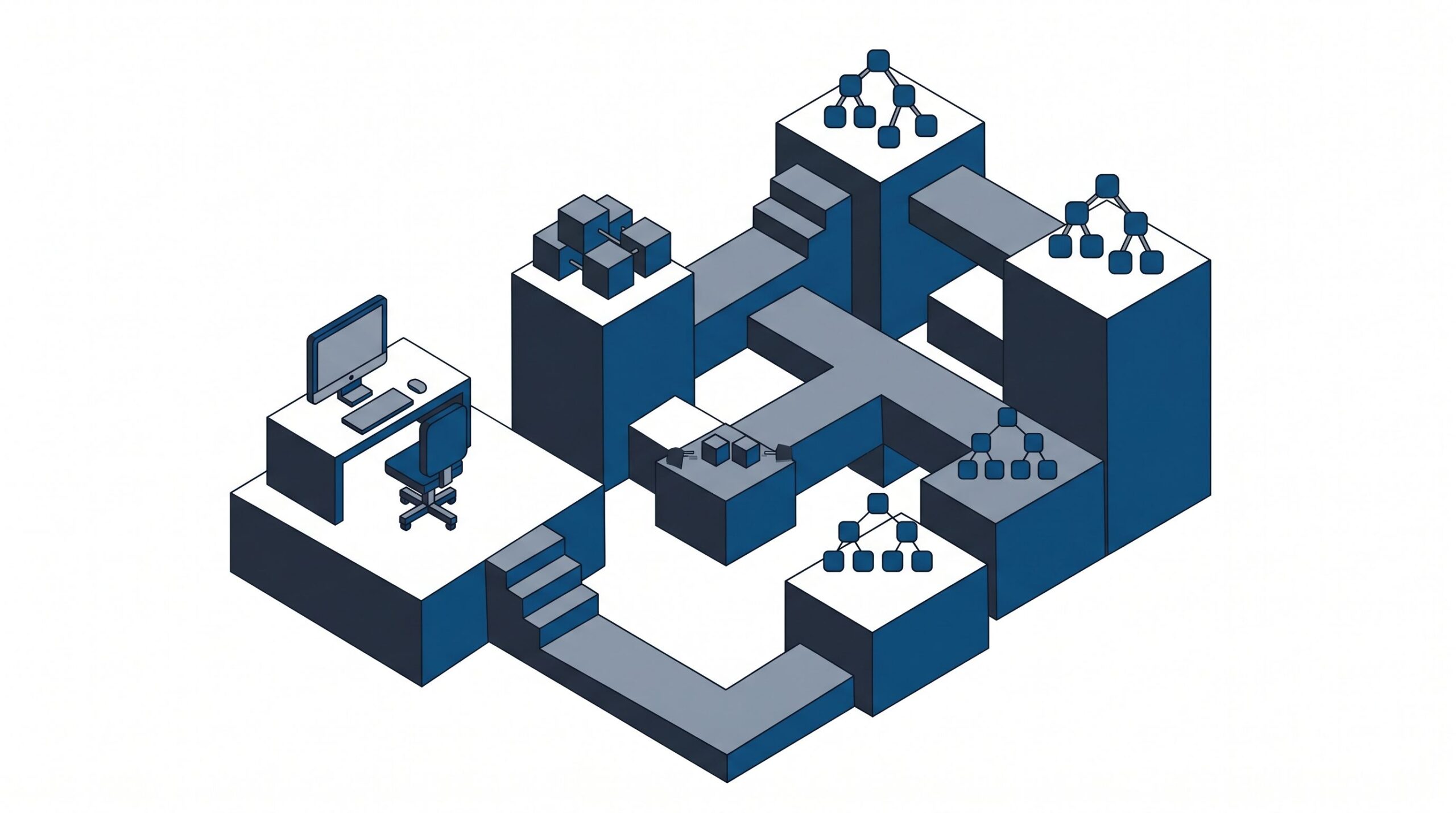
What Front-End Development Actually Is
Front-end development is the rigorous engineering discipline of building scalable user interfaces and managing complex application state within the browser environment. It requires translating abstract business requirements into accessible, performant, and maintainable code. You are not simply painting colorful buttons on a screen. You are managing asynchronous data flows, optimizing critical rendering paths, and neutralizing browser inconsistencies. Forget the six-week zero-to-hero promises peddled online. Becoming a competent engineer takes months of failing, debugging, reading technical documentation, and breaking things.
1. The Non-Negotiable Core
To get hired, you must understand exactly how the browser engine parses code into the visual interface the user interacts with. HTML provides the immutable semantic structure. CSS handles the visual layout and responsive breakpoints. The Document Object Model acts as the programmable interface between your code and the browser rendering engine.
- Semantic Architecture: Stop using generic container tags for every element. Screen readers and search engine crawlers rely on precise semantic tags to understand page context and hierarchy. Navigation elements, main content areas, and structural footers require explicit tag definitions.
- CSS Engineering: Flexbox and Grid solve ninety percent of modern layout problems. Learn them deeply before touching a utility framework. You must understand the cascade, specificity hierarchies, and how to structure stylesheets so they do not collapse under the weight of a massive enterprise project.
- DOM Manipulation: Before you even look at a JavaScript framework, you must know how to select elements, attach persistent event listeners, and mutate the DOM using raw JavaScript. Relying on abstractions too early creates weak engineers.
2. JavaScript Reality Check
JavaScript is the functional core of modern web applications. You cannot copy and paste your way through complex state logic or authentication flows. If your foundation here is weak, frameworks will feel like unpredictable magic, and production bugs will be impossible to trace.
- Execution Context and Closures: You must understand how variables are scoped, hoisted, and retained in memory. This knowledge is fundamental for avoiding catastrophic memory leaks in single-page applications.
- Asynchronous Processing: The modern web runs entirely on network requests. Master Promises and the asynchronous await syntax. You must know how to handle API failures gracefully without crashing the entire application interface.
- Data Transformation: Get extremely comfortable with native array methods like map, filter, and reduce. You will spend a massive portion of your career transforming raw, messy API payloads into clean data structures suitable for component rendering.
const fetchUserData = async (endpointUrl) => {
 try {
 const response = await fetch(endpointUrl);
 if (!response.ok) {
 return null;
 }
 const data = await response.json();
 return data;
 } catch (error) {
 console.error(error);
 return null;
 }
 };
3. The Framework Ecosystem
Do not learn React until you understand exactly what architectural problems it solves. Frameworks solve the persistent engineering problem of keeping the user interface perfectly synchronized with constantly changing application state. React remains the undisputed industry standard for enterprise applications.
- Component Architecture: Break complex interfaces into small, reusable, and heavily testable pieces. A component should ideally execute one specific function perfectly.
- State and Props Synchronization: Data strictly flows down through props. State manages internal data that changes over time within a specific component. Mismanaging this unidirectional flow leads to deeply unpredictable interface bugs.
- The Component Lifecycle: You must understand exactly when a component mounts to the DOM, when it updates, and when it unmounts. This lifecycle awareness is critical for optimizing rendering performance and systematically cleaning up rogue event listeners.
- Global State Management: Redux is heavily utilized in legacy enterprise applications; however, Zustand and the native Context API handle most modern state requirements efficiently. Always choose the simplest architectural tool that solves your specific problem.
Version Control and CI/CD Reality
Writing code is only half the job. Delivering it reliably and safely to production is the other half. You will collaborate with dozens of other engineers, and you absolutely need a strict system to prevent total repository chaos.
- Git Fundamentals: You must know how to branch, commit, merge, and rebase from the command line. Knowing how to resolve a severe merge conflict without panicking is a mandatory daily job skill.
- Pull Request Etiquette: This is where rigorous code reviews happen. Your code will be critiqued heavily. Leave your ego completely at the door, accept brutal feedback, and learn to review the code of your peers constructively.
- Deployment Pipelines: Learn the foundational basics of GitHub Actions. Enterprise code must pass automated testing suites and strict build processes before it ever reaches a live production server.
The Cold Truth About Entry-Level Roles
The technical influencer ecosystem actively sells a false reality of immediate high salaries and remote work from tropical beaches. The junior market is highly saturated and aggressively competitive.
- The First Role: Your first job is strictly about getting paid to learn enterprise software development. Do not optimize exclusively for base salary. Optimize heavily for engineering culture and technical mentorship. Working directly under a strict Senior Engineer will accelerate your career infinitely faster than a massive initial paycheck at a completely disorganized startup.
- The Portfolio Trap: Building another generic weather application will not get you a technical interview. Build robust applications that solve real business problems, consume complex external APIs, handle persistent user state, and are actively deployed live on the internet.
- Continuous Failure: You will inevitably break production environments. You will write highly inefficient algorithms. The core difference between a junior developer and a senior developer is simply the sheer volume of catastrophic mistakes made and subsequently learned from. Keep writing code. Keep shipping software.